

Amacx Gel vs e-Gel | Which is Better?
e-Gel vs Amacx Gel
HEAD TO HEAD COMPARISON
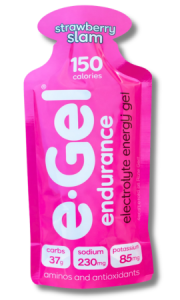
vs
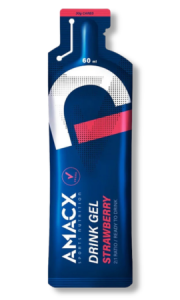
Amacx Gel is from the Netherlands and uses a solid carbohydrate blend of maltodextrin and fructose. Amacx gets several things right: meaningful sodium (200mg), multiple flavors, and a caffeine option. But across the metrics that matter most for endurance performance — calories, total carbs, complex carb percentage, electrolytes, amino acids, and antioxidants — e-Gel delivers more options and more good stuff in every pack.
calories
e-Gel
150
Amacx
120
Each pack of e-Gel provides 25% more energy than an Amacx Gel. Over the course of a multi-hour race, that adds up — fewer packets to manage and more energy per intake when it counts.
total carbs
e-Gel
37g
Amacx
30g
e-Gel delivers more carbs per pack than Amacx. Carbs are the main reason you use an energy gel in the first place. They are the primary fuel your muscles use during exercise, so more carbs per pack means more energy delivered every time you fuel.
complex carbs
e-Gel
30g
82% of total
Amacx
18g
60% of total
Both e-Gel and Amacx use complex carbs — a good thing compared to competitors that rely on 100% simple sugar. But e-Gel delivers 67% more complex carbs per pack (30g vs 18g) and a higher ratio (82% vs 60%), with only 7g of sugar compared to 12g in Amacx gel.
why complex carbs matter
Energy gels are absorbed via osmosis — the process where fluid crosses a membrane. For the gel to be absorbed, it has to be diluted with water until it reaches the same concentration as your cellular fluids (isotonic). You drink water with your gel to make this happen.
Here’s the key: the concentration of a fluid depends largely on the number of particles, not their size. Complex carbs like maltodextrin have much larger molecules than simple sugars — essentially multiple glucose molecules bonded together. Because it’s the particle count that matters, a fluid with complex carbs can transport nearly twice as much energy at the point of absorption compared to one with simple sugars.
Both e-Gel and Amacx use maltodextrin, so both benefit from this principle. Where e-Gel sets itself apart is the ratio: 82% complex carbs with only 7g of sugar, compared to AMACX’s 60% complex carbs and 12g of sugar. That means more of every e-Gel pack is in the form that your body absorbs most efficiently.
Why does this matter? A higher ratio of complex carbs means more energy delivered per unit of fluid absorbed. During a long race, that efficiency advantage compounds — more energy getting to your muscles from each intake, with less osmotic stress on your gut.
cost benefit
e-Gel delivers 25% more calories per pack for less money. More for less is a good deal!
carb sources
e-Gel
maltodextrin
fructose
Amacx
maltodextrin
fructose
Both e-Gel and Amacx use the same carbohydrate sources — maltodextrin as the primary carb and fructose as the secondary. This means both products take advantage of dual-pathway absorption, which is the right approach.
why fructose?
Your body absorbs glucose and fructose through two different transporters in the gut. Glucose (and maltodextrin, which breaks down into glucose) uses the SGLT1 transporter, while fructose uses the GLUT5 transporter. By including both carb types, a gel can push total carbohydrate absorption beyond the ~60g/hour limit of glucose alone — potentially up to 90g/hour or more.
Both e-Gel and Amacx get this right. The difference between the two products isn’t the carb sources — it’s the amount and ratio. e-Gel delivers 37g of carbs per pack (82% complex) compared to AMACX’s 30g (60% complex). If you use too much fructose you risk maxing the GLUT5 transporter meaning, thus slowing absorption and energy uptake, and potentially causing GI distress.
sodium
e-Gel
230mg
Amacx
200mg
Both e-Gel and Amacx include meaningful sodium — Amacx is one of the few competitors that actually puts solid electrolytes in the gel. e-Gel provides 15% more sodium per pack.
electrolytes and the "no water needed" claim
Electrolytes are critical to maintain hydration and to avoid cramping and injuries. Many gel companies leave electrolytes out entirely — Styrkr, Precision Fuel’s PF 30, and Enervit’s C2:1PRO all have zero sodium. These companies sell separate electrolyte supplements, which means more products to buy and more to figure out during a race. Credit to Amacx for including 200mg — that’s better than most.
Amacx markets its Drink Gel as not requiring water — the gel is pre-mixed with water for a thinner, liquid consistency. While the thinner texture makes it easier to consume at high intensity, athletes still need to drink water during exercise. Energy gels are absorbed via osmosis, and your body needs adequate water intake for proper absorption regardless of the gel’s consistency. The water in the gel helps with swallowing, but it doesn’t replace the water your body needs for hydration, temperature regulation, and gel absorption.
There’s a good reason to put electrolytes in the gel rather than in a sports drink: if you use a sports drink with your gel, the combined solution in your gut becomes too concentrated (hypertonic), slowing absorption and potentially causing stomach discomfort. With e-Gel, you just use water — the electrolytes are already in the gel, calibrated to deliver 500mg of sodium and 200mg of potassium per liter of absorbed fluid, meeting the American College of Sports Medicine’s recommendations.
potassium
e-Gel
85mg
Amacx
0mg
Potassium works alongside sodium to maintain hydration and prevent cramping. e-Gel provides 85mg per pack. Amacx provides none.
potassium discussion
Potassium is the other electrolyte that’s critical to replace during training and competition. While sodium gets most of the attention, potassium plays a key role in muscle contraction and fluid balance. Losing too much without replacement can contribute to cramping, fatigue, and decreased performance.
This is where Amacx’s electrolyte profile falls short. Despite including 200mg of sodium — which is commendable — Amacx provides zero potassium. That’s a significant gap for an energy gel marketed toward endurance athletes. e-Gel’s 85mg per pack is designed to meet the American College of Sports Medicine’s recommendation for potassium replacement during athletic activity, proportional to the water that carries the gel into your system.
amino acids
e-Gel
histidine, leucine,
valine, isoleucine
Amacx
none
e-Gel provides four important amino acids that help reduce lactic acid buildup, reduce soreness, maintain muscle protein, and aid in quicker recovery. Amacx Drink Gel does not contain any amino acids.
amino acid discussion
During prolonged exercise, your body begins breaking down muscle protein for energy — a process called catabolism. The branched-chain amino acids (BCAAs) leucine, valine, and isoleucine help counteract this by providing an alternative fuel source and signaling your body to preserve muscle tissue.
Histidine plays a different role: it’s a precursor to carnosine, which acts as a buffer against the acid buildup in muscles that contributes to fatigue and that burning sensation during hard efforts. Together, these four amino acids support performance during the effort and faster recovery afterward.
Most energy gels — Amacx included — don’t include amino acids. It’s one more area where e-Gel goes beyond just delivering calories.
antioxidants
e-Gel
vitamin C
vitamin E
Amacx
none
Antioxidant vitamins C and E help protect against tissue damage, reduce soreness, and aid in recovery. Amacx Gel does not provide any antioxidants.
antioxidant discussion
Intense exercise increases the production of free radicals — unstable molecules that can damage cells and contribute to inflammation and soreness. Vitamins C and E are antioxidants that help neutralize these free radicals, protecting tissue and supporting the recovery process.
During a long race or hard training session using e-Gel, you’re building up meaningful antioxidant protection throughout the effort. It’s another way e-Gel is designed as complete athletic fuel — not just a source of calories.
caffeine
e-Gel
optional
6 uncaffeinated flavors
3 caffeinated “Turbo” flavors
Amacx
1 option
Both e-Gel and Amacx offer a caffeinated option — a good thing, since having the choice matters. e-Gel gives you three caffeinated Turbo flavors. AMACX offers one caffeinated flavor (Cola).
caffeine discussion
Caffeine is one of the most well-researched performance enhancers in sports science. It reduces perceived effort, improves focus, and can delay fatigue — particularly valuable in the later stages of a long race when mental sharpness matters most.
Having the option is key. Most athletes don’t want caffeine on every intake, and many prefer to save it for strategic moments late in a race. Both e-Gel and Amacx let you choose when to use caffeine and when to skip it — a better approach than gels that put caffeine in every pack or offer no caffeine at all.
The difference is variety: e-Gel’s three caffeinated Turbo flavors let you rotate through different tastes even in your caffeinated intakes. Amacx limits you to one caffeinated flavor (Cola). If you plan to use caffeine at multiple points during a long race, that’s the same taste every time.
citrates
e-Gel
✓
included
Amacx
✓
included
Both e-Gel and Amacx gel include citrates, which assist in the carbohydrate-to-energy conversion process and help buffer lactic acid buildup. Many competing gels don’t include citrates at all, so this is one area where both products deliver.
flavors
e-Gel
9
Amacx
5
e-Gel offers nine flavors — six original and three caffeinated (e-Gel Turbo). AMACX offers five: Strawberry, Raspberry, Citrus, Orange, and Cola (caffeinated). More variety means more rotation options during multi-hour events.
flavor variety discussion
Five flavors is better than one — AMACX at least gives you options. But during a long race, the depth of your rotation matters. With five flavors (and one reserved for when you want caffeine), you’re working with four non-caffeinated options. Over a long race or training block, that rotation can start to feel repetitive.
e-Gel’s nine flavors — six non-caffeinated plus three caffeinated Turbo — give you enough variety that you rarely have to take the same flavor twice in a row, even during the longest events. When you’re several hours into a race and every intake matters, having a flavor you’re actually looking forward to makes a real difference.
100 world record fueled by e-Gel
Ashley Paulson set the women’s 100-mile world record (12:19:34) fueling with 300+ calories per hour of e-Gel and e-Fuel for over 12 hours — with zero gut issues. When trying a new gel you want to know if it will be easy on the stomach and if it will actually give you the energy you need to perform your best. While every athlete is different, what actually achieved using e-Gel is pretty strong evidence that it will work for you!