

SiS Beta Gel vs e-Gel | Which is Better?
e-Gel vs SiS Beta Gel
HEAD TO HEAD COMPARISON
vs
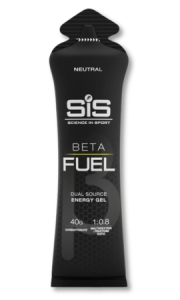
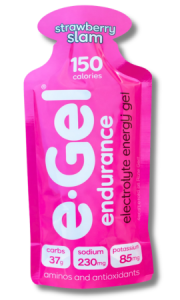
SiS Beta Fuel Gel delivers 40g of carbohydrates per pack using maltodextrin and fructose. It’s a carb delivery system — but that’s all it is. Beta Fuel contains just 30mg of sodium, zero potassium, no amino acids, no antioxidants, and no caffeine option. e-Gel delivers 37g of carbs with a significantly higher complex carb ratio, plus 230mg sodium, 85mg potassium, amino acids, antioxidants, and an optional caffeine version. Here’s the full nutrition breakdown.
calories
e-Gel
150
Beta Gel
158
Beta Gel delivers slightly more calories per pack — 158 vs 150. That’s a 5% difference. On raw calories alone, they’re comparable. The real question is what else comes with those calories: e-Gel packs electrolytes, amino acids, and antioxidants into every serving. Beta Fuel delivers carbs and little else.
calorie discussion
Calories per pack is a useful number, but it’s not the only one that matters during a race. What you want is the most complete nutrition per intake — not just energy, but the electrolytes, amino acids, and antioxidants that keep your body performing and recovering as you go.
If you’re targeting 300+ calories per hour (as Ashley Paulson did during her 100-mile world record at 350+ cal/hr), two packs of e-Gel gives you 300 calories, 460mg sodium, 170mg potassium, amino acids, and antioxidants — all in two intakes. Two packs of Beta Fuel gives you 316 calories and 60mg of sodium. For everything else, you’re on your own.
total carbs
e-Gel
37g
Beta Gel
40g
Beta Gel delivers 3 more grams of carbohydrate per pack — 40g vs 37g. SiS markets this heavily as “40g of carbs in a single gel.” It’s a legitimate number. But the type of carbohydrate matters as much as the amount, and nearly half of Beta Fuel’s carbs are simple sugar.
total carbs discussion
SiS Beta Gel’s 40g of carbs breaks down to roughly 21g of complex carbs (maltodextrin) and 19g of sugar (fructose) — a 52% complex carb ratio. e-Gel’s 37g breaks down to 30g of complex carbs and 7g of sugar — an 82% complex carb ratio.
Why does this matter? Because of how gels are absorbed. Energy gels are absorbed via osmosis, which depends on the number of particles in solution — not their size. Complex carb molecules carry much more energy per particle than simple sugar molecules. See the complex carbs section below for the full breakdown.
complex carbs
e-Gel
30g
82% of total
Beta Gel
21g
52% of total
This is a very significant differentiator. e-Gel delivers 30g of complex carbohydrates per pack (82% of total carbs). Beta Gel delivers 21g (52% of total carbs). Despite having a few more calories, Beta Gel has significantly less complex carbohydrate — and that directly affects how much energy your body can absorb per intake.
why complex carbs matter
Energy gels are absorbed via osmosis — the process where fluid moves across a membrane. For a gel to be absorbed, it must be diluted with water until it reaches the same concentration as your cellular fluids (isotonic). You drink water with your gel to make this happen.
Here’s the key: the concentration of a fluid depends on the number of particles, not their size. Complex carbs like maltodextrin have much larger molecules than simple sugars — each one is essentially multiple glucose molecules bonded together. Because it’s the particle count that determines concentration, a fluid with complex carbs can transport nearly twice as much energy at the point of absorption compared to one with simple sugars.
SiS markets their 1:0.8 maltodextrin-to-fructose ratio as an innovation for dual-pathway absorption. And using some fructose does help — it activates a second absorption transporter. But their ratio pushes fructose to nearly half the total carbs, which significantly reduces the energy density advantage of using complex carbs in the first place. e-Gel’s 82% complex carb ratio strikes a different balance: maximize the osmotic energy advantage of maltodextrin while still including enough fructose for dual-pathway absorption.
cost benefit
Beta Gel is one of the most expensive energy gels on the market — significantly more per pack than e-Gel. And for that premium price you get 8 more calories and none of the good stuff in e-Gel. No meaningful electrolytes, no amino acids, no antioxidants, no caffeine option. e-Gel costs less per pack while delivering more complete nutrition. When you break it down by cost per calorie, cost per gram of carbohydrate, or cost per milligram of sodium, the gap gets even wider.
value discussion
The price-per-pack comparison alone favors e-Gel. But the real cost story is what happens when you try to match e-Gel’s nutrition using SiS products. Beta Gel gives you carbs — and that’s it. To get electrolytes they recommend their Hydro tablets or GO Electrolyte powder. For caffeine, their caffeine gum. For amino acids and antioxidants, you’re on your own.
Stack those products up and the cost difference compounds: you’re paying a premium for Beta Gel, then paying again for hydration products, then again for caffeine — and you still don’t have amino acids or antioxidants. e-Gel puts everything in one pack at a lower price point than Beta Gel alone. Less cost, more nutrition, zero complexity.
carb sources
e-Gel
maltodextrin
fructose
Beta Gel
maltodextrin
fructose
Both products use the same two carbohydrate sources: maltodextrin and fructose. The difference is the ratio. SiS uses a 1:0.8 maltodextrin-to-fructose ratio — meaning nearly equal parts of each. e-Gel uses roughly 82% maltodextrin and 18% fructose, heavily favoring the complex carb.
why fructose?
Your body absorbs glucose and fructose through two different transporters in the gut. Glucose (and maltodextrin, which breaks down into glucose) uses the SGLT1 transporter, while fructose uses the GLUT5 transporter. By including both carb types, you can push total carbohydrate absorption beyond the ~60g/hour limit of glucose alone — potentially up to 90g/hour or more.
SiS’s 1:0.8 ratio is designed to push maximum carbs through both pathways simultaneously. The trade-off is that nearly half their carbs are simple sugar, which reduces the osmotic energy density advantage of complex carbs. e-Gel includes enough fructose to activate the dual-pathway effect but keeps the ratio heavily weighted toward complex carbs — maximizing the energy delivered per unit of fluid absorbed.
sodium
e-Gel
230mg
Beta Gel
30mg
e-Gel provides nearly 8 times more sodium per pack than Beta Fuel — 230mg vs 30mg. Beta Gel’s 30mg of sodium is negligible for electrolyte replacement during exercise. For context, most athletes lose 500–1,500mg of sodium per hour through sweat. At two gels per hour, Beta Gel replaces 60mg. e-Gel replaces 460mg.
why electrolyte belong in the gel
Sodium is the primary electrolyte lost in sweat and the most important to replace during endurance exercise. It helps maintain blood volume, supports fluid absorption, and prevents hyponatremia — a dangerous condition caused by low sodium levels during prolonged activity.
Beta Gel’s 30mg of sodium comes from sodium citrate and sodium chloride in the ingredients, but at that level it’s essentially a rounding error in your electrolyte needs. SiS addresses this by selling separate hydration products (Hydro tablets, GO Electrolyte powder), but that means more products, more cost, and more complexity on race day.
e-Gel’s 230mg per pack is calibrated to deliver approximately 500mg of sodium per liter of absorbed fluid, meeting the American College of Sports Medicine’s recommendation for sodium replacement during athletic activity. And because the electrolytes are in the gel — not in a separate drink — you avoid the osmotic problems of combining a gel with a sports drink. You just use water.
potassium
e-Gel
85mg
Beta Gel
0mg
Beta Gel contains zero potassium. The only potassium-containing ingredient is potassium sorbate — a preservative, not a nutritional source. e-Gel provides 85mg per pack to support muscle contraction and fluid balance during exercise.
potassium discussion
Potassium works alongside sodium to maintain hydration, support nerve signaling, and enable proper muscle contraction. Losing too much without replacement contributes to cramping, fatigue, and decreased performance.
e-Gel’s 85mg per pack is designed to meet the ACSM’s potassium replacement recommendation, proportional to the water that carries the gel into your system. Two packs per hour delivers 170mg of potassium — meaningful replacement that Beta Fuel simply doesn’t provide.
amino acids
e-Gel
histidine, leucine,
valine, isoleucine
Beta Gel
none
e-Gel provides four amino acids that help reduce lactic acid buildup, minimize muscle damage, and support faster recovery. Beta Fuel does not contain any amino acids.
amino acid discussion
During prolonged exercise, your body begins breaking down muscle protein for energy — a process called catabolism. The branched-chain amino acids (BCAAs) leucine, valine, and isoleucine help counteract this by providing an alternative fuel source and signaling your body to preserve muscle tissue.
Histidine serves a different purpose: it’s a precursor to carnosine, which buffers the acid buildup in muscles that contributes to fatigue and that burning sensation during hard efforts. Together, these four amino acids support both performance during the effort and faster recovery afterward.
Beta Gel’s ingredient list is focused entirely on carbohydrate delivery: water, maltodextrin, fructose, gelling agents, and preservatives. It’s a carb transport vehicle — nothing more.
antioxidants
e-Gel
vitamin C
vitamin E
Beta Gel
none
Antioxidant vitamins C and E help protect against tissue damage, reduce soreness, and support recovery from intense exercise. Beta Fuel does not provide any antioxidants.
antioxidant discussion
Intense exercise increases the production of free radicals — unstable molecules that damage cells and contribute to inflammation and soreness. Vitamins C and E are antioxidants that neutralize these free radicals, protecting tissue and supporting recovery.
During a long race or hard training session using e-Gel, you’re building up meaningful antioxidant protection throughout the effort. It’s another way e-Gel is designed as complete athletic fuel — not just a source of calories. Beta Gel’s formula doesn’t include any — another category where it leaves you to find a separate solution.
caffeine
e-Gel
optional
6 uncaffeinated flavors
3 caffeinated “Turbo” flavors
Beta Gel
none, no option
e-Gel gives you the choice. Six of our nine flavors have zero caffeine. The other three — our caffeinated line, called e-Gel Turbo — deliver 50mg per pack for when you want a boost. Beta Gel does not offer a caffeinated option at all.
caffeine discussion
Caffeine is one of the most well-researched performance enhancers in sports science. It reduces perceived effort, improves focus, and delays fatigue — particularly valuable in the later stages of a long race when mental sharpness matters most.
Having the option is what matters. e-Gel Turbo’s 50mg per pack gives you precise control: you can rotate caffeine-free flavors through most of the race and add a Turbo when you need the boost. With Beta Fuel, that option doesn’t exist — if you want caffeine, you need yet another product.
SiS does sell caffeinated products in other forms (caffeine gum, for example), but that’s another item to buy, carry, and manage during a race. e-Gel puts the option right in the gel.
citrates
e-Gel
✓
included
Beta Gel
✓
included
e-Gel includes both sodium citrate and potassium citrate, which assist in converting carbohydrates to energy and help buffer lactic acid buildup. Beta Gel includes sodium citrate but not potassium citrate — it doesn’t contain any potassium compounds beyond the preservative potassium sorbate.
flavors
e-Gel
9
Beta Gel
3
e-Gel offers nine flavors — six original (e-Gel Endurance) and three caffeinated (e-Gel Turbo) — so you can build a rotation that keeps fueling interesting across a multi-hour race. Beta Gel offers three options: Orange, Strawberry & Lime, and Neutral (unflavored).
flavor variety discussion
Three flavors is better than one, but during a race lasting 4, 8, or 12+ hours where you’re taking a gel every 30–45 minutes, variety matters. Flavor fatigue is real — even a flavor you love at mile 5 can become hard to choke down at mile 80.
With nine flavors, e-Gel gives you enough variety that you never have to take the same flavor twice in a row. Rotate through Cherry Bomb, Tropical Blast, Mountain Rush, and others, and each intake feels like a reset. Making nine flavors is expensive — it requires separate production runs and significantly more complex inventory management — but Crank Sports does it because variety is how you fuel for the long haul.
why 9 flavors matters
Three flavors sounds reasonable until you’re taking a gel every 30 minutes for 6 hours straight. That’s 12 gels — cycling through the same three tastes four times each. By the third rotation, even a flavor you liked at the start can become something you dread.
With nine flavors, you can take 12 gels without repeating a single one. We put serious work into making flavors that athletes actually look forward to taking — because when you’re deep into a race, enjoying your gel matters. Six original flavors plus three caffeinated Turbo means you can build a rotation that stays interesting from start to finish.
100 world record fueled by e-Gel
Ashley Paulson set the women’s 100-mile world record (12:19:34) fueling with 300+ calories per hour of e-Gel and e-Fuel for over 12 hours — with zero gut issues. When trying a new gel you want to know if it will be easy on the stomach and if it will actually give you the energy you need to perform your best. While every athlete is different, what actually achieved using e-Gel is pretty strong evidence that it will work for you!